
Available Now — First Edition

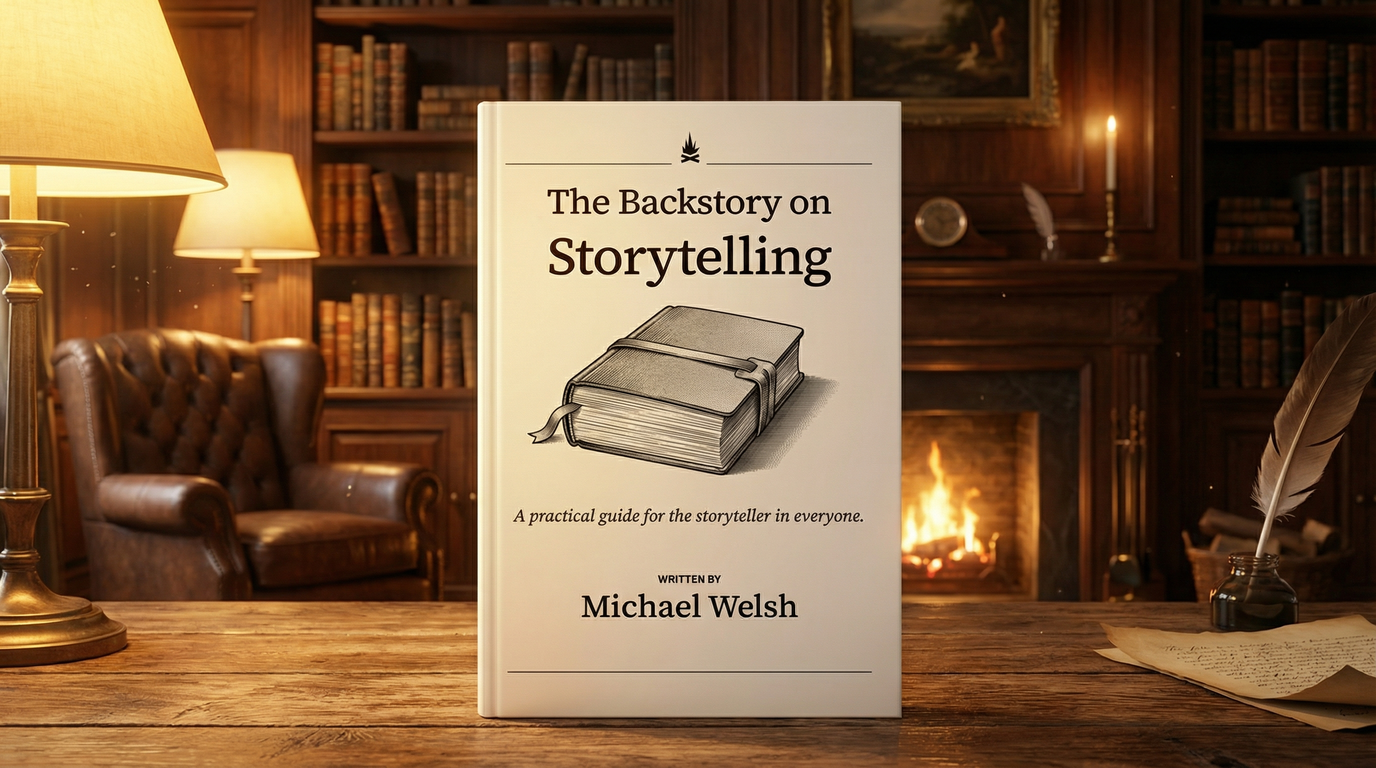
The Backstory on Storytelling

A practical guide for the storyteller in everyone.

The Backstory on Storytelling — book cover
"Every person on this planet has a story — and the power to tell it well." — Michael Welsh

Why Storytelling
Changes Everything

Storytelling is the oldest, most powerful form of human communication — and yet most of us never learned how to do it well. The Backstory on Storytelling breaks down the craft of compelling narrative in a direct, practical, and deeply human way.

Whether you're a marketer, entrepreneur, speaker, educator, parent, or just someone who wants to connect more authentically with the people around you — this book will give you the tools, perspective, and confidence to tell your story with clarity and impact.

Start Reading

Practical Frameworks

Real techniques you can apply immediately — no theory overload, just tools that work.

Human Connection

Learn how authentic storytelling builds trust, empathy, and lasting relationships.

For Everyone

From seasoned professionals to first-time speakers — this guide meets you where you are.

Discover Your Voice

Uncover your unique narrative style and tell stories only you can tell.

Read the First Pages

The Foreword, Chapter 1 & Chapter 2 — read free below.

1/11

Foreword

The Foreword on the Backstory

This book exists because of a simple truth I've learned over more than two decades in business, design, and human connection: teams make leaders, not the other way around.

The pages that follow are not a traditional leadership manual. They won't give you a five-step process to executive success or promise to unlock your hidden potential in thirty days. Instead, this is the story of how curiosity, vulnerability, and the ancient art of storytelling can transform not just how we communicate, but how we show up for each other in the complex world of modern work.

That statement — which you'll encounter throughout this book — became my north star after years of thinking I had to have all the answers. It led me from being an arrogant designer who believed his own hype to understanding that the most powerful question any leader can ask is: "How can I help?"

The backstories of storytelling you'll read here span from our earliest human ancestors sharing stories around fires to modern boardrooms, where the right narrative can change everything. They include personal failures, family dynamics, agoraphobia, and the discovery that our deepest vulnerabilities often become our greatest strengths.
Foreword, continued

You'll learn about the 5 Slide Rule — not because it's revolutionary, but because it forces us to respect the gift of someone else's attention. You'll discover why three is more than a magic number and how the arc of uncertainty can become a roadmap for innovation. Most importantly, you'll see how embracing our own ignorance and leaning into curiosity can create the conditions where teams naturally elevate their leaders.

This book is organized around four foundational areas that have shaped my understanding of how humans connect, create, and lead together:

  • Foundations explores the making of a storyteller — from childhood experiences in a chaotic Philadelphia household to an understanding of the evolutionary biology that makes humans wired to share narratives.
  • The Craft dives into the principles and techniques developed over years of presenting, pitching, and occasionally failing spectacularly in front of audiences.
  • The Performance addresses the reality that how we show up matters as much as what we say — the poise, presence, and posture that can make or break a moment of connection.
  • The Practice offers concrete tools and methods you can use immediately, from interview techniques that actually reveal character to frameworks for business storytelling that drive real results.

The stories in this book are true. The techniques have been tested in countless rooms with teams from all over the world. The failures are documented as thoroughly as the successes because they're often more instructive.

As my father used to say, "Showing up is half the battle." This book is about how to show up — authentically, curiously, and in service of something larger than ourselves.

Let's begin.
Mike Welsh, 2026

Chapter 1

My Mom Made Me a Storyteller

My mother said I had the gift of gab. I was a chatty child, and in a large family, getting a word in edgewise was hard. Somewhere back there, it began. In fights, I would talk my way out rather than just fighting it out. Girls, if they even paid a little attention, rather than making out, I would nervously talk them to death. More than anything else I can recall, these are where my storytelling roots began to grow slowly.

From a very early age, I was surrounded by articulate and intelligent individuals. These included my siblings, extended family, neighbors, teachers, and mom and dad.

The Family Dynamic

Siblings — those people you didn't pick to be on earth with, but without them, I'd be lost. They played a key role in shaping my storytelling skills. While on a family trip in the Poconos with another family, I claimed to have encountered a bear and wrestled it off. A tall tale for sure. My brothers verbally bludgeoned me for that then and jabbed me on it today. I got some attention, albeit not the kind I expected.

Bears hibernate. Duh. 🙄

I was making it up for the attention. The reason was that I felt left out most of the time. Being a storyteller means you could be let in, if only briefly. Tell your story and keep moving. I wanted to be part of the story.

Chapter 1, continued

The Mathematics of Family

4th son of 6 children, a set of twins, and three brothers on the planned kids side of the Sears' portrait balance sheet. Myself, oops baby, and my sisters (twins). The maths work out like this:

Frank / Frankie — the lord Fauntleroy of the manor, Frank Jr., btw. Could do little wrong and was nearly ten years my senior. Also, the last of the boomers. He became a man of letters, erudite, well-written, well-read, and a bit of a bon vivant. He danced in front of the mirror to Peter Frampton. Our shared room in the basement was filled with loads of Polo® and Drakar® colognes. Frankie passed away on February 22, 2022, too soon and too young.

Tom / Tommy — Number 2, close in age, the next in the planned set of kids. Brilliant, an athletic STEM kid, analytical, and focused on engineering science and experimental criming. You know, setting fires, blowing stuff up, a little B&E, and quite a ladies' man. Adventures with Tom could end in handcuffs or fire damage. He had little fear and less memory of trauma. A gift some would lament.

Patrick / Murph — Number 3 of the Sears® portrait kids, Murph, as Frank named him. Patrick was a remarkable hustler — a collector of sorts. He excelled at selling, persuading, and making deals of all kinds. He developed a sixth sense for engaging and running the tables at any table he was at. We used to play Stratego®. I would have my back and board pieces to the window. Later, he admitted that the backlighting would let him see my pieces. This brother could sell a polar bear ice cube handcuffs in a blizzard.

Chapter 1, continued

Then, 4+ years later, I am accidentally born. I am now in the mix as the baby boy, 4th of 6th. The three older boys are reasonably close in age — they operated as their own unit. As the 4th kid, I faced many disadvantages. Being separated by nearly 4 years imposed limits. But there was one key advantage. My relationship with my mom and dad was markedly different. I was the 'baby' for at least six years until my sisters were born. I was my mom's sidekick.

The Gift of Observation

When I was about 3, she got her driver's license. At that time, we only had one car — still, it was a new kind of freedom for my mom. She could go places and do things on her own. She took me everywhere. We did all the things, like Pathmark™ with two carts, full of Golden Grams, Puffed Wheat, No Frills canned goods, and all the Salisbury Steak we could afford. Everywhere we went, women were talking and connecting.

I was exposed early to my brothers' smartness and protection. We all experienced the normal abuse under my dad's iron fist rule and his budding alcoholic regime. More on all that in another book someday.

Between the ages of 9 and 11, I developed agoraphobia — an anxiety disorder characterized by an intense fear of being in situations where escape might be difficult or help might not be available. I demonstrated an early 'gift-of-gab'. Again, I was mainly a voice in the wilderness of these half dozen kids. We lived in a one-bathroom house led by a homicide detective and a stay-at-home mom.

The Changing Landscape

Put aside for a moment all the dysfunctional sh*t — I'm Generation X, and no one cared or cares. You went out and played. You came home when you heard your mom or dad whistle. No phones, just freedom.

Chapter 1, continued

The Lessons

Today, being in my comfort zone makes me physically ill, and proving people wrong sparks joy. I have forgiven my parents, the sibs, and the circumstances. This forgiveness has allowed me to get past most of the FU in my dysfunction.

  • I am my mother's son. I was her favorite. Moms are first for everything for their children.
  • I was a 'two-burner Mike' according to my mother's assessment of my potential. I operate at like a six-burner Viking cooktop today, fueled by harnessed hate fire for a world that assumed I wouldn't amount to a 'hill of beans.'
  • Being underestimated most of my life isn't always a bad thing. I think to be excellent, there should be a misunderstood person standing there, proving them wrong by becoming an 'applied human' — someone in service to others, getting sh*t done.
  • Forgiveness is for me. I forgave all those who've tried to hurt me, stop me. I am not the most intelligent person in the world, but I know how to persist and persevere.

You may not relate, be put off, or laugh a solid amount, but we all come from stories — stories we tell or are told about us. Those stories are why we are who we are.

"Call your siblings, or the adopted ones, or the ones you picked. Those we associate with reflect who and what we are."

Chapter 2

The Back Story on Storytelling

All humans, including you, are storytellers by definition and evolution. Even if you believe you aren't good at public speaking, talking to strangers, presenting, or pitching — you are genetically designed to be a storyteller. It's in our DNA. Epigenetically speaking, we are evolved to share stories.

Prehuman Foundations

Prehuman species (before Homo sapiens) displayed capacities for understanding, recalling, and communicating events — mainly through mimetic (imitative) methods, such as gestures, facial expressions, and vocalizations, but not actual language or narrative.

Today, we use this as a nonverbal signal we send almost without thought, at least not consciously. Reading someone's body language is a good example of how this translates to today. It's a super-intuitive way to understand a person before they speak. I reference this in my Five Slide Rule training as the 3 Ps: Poise, Presence, and Posture.

Emergence of Language

The pressure for complex social cooperation among Homo Erectus and later hominids led to the invention of language. Linguistic anthropologists estimate that spoken language began to develop around 500,000 years ago, enabling richer, more precise communication.

So when storytelling, consider hundreds of thousands of years and countless human generations of our predecessors who communicated precisely for our literal survival. Our inheritance is enormous — so when you are nervous or feel like you are struggling, remember: if there is no struggle, there is no progress.

Chapter 2, continued

Proto-Narrative Communication

Gestures, postures, and expressions provided early means for sharing stories and information before the concept of whole language emerged. Artistic expressions such as cave paintings, carvings, and figurines — including ancient artifacts such as the Venus of Berekhat Ram — served as preliterate means of storytelling and symbol creation.

From those caves in France to emojis. 🦄🙈🫶

Even people who could not read or write still managed to share something with others. At this early point, we installed the 'pictures are worth a 1,000 words' model in our primitive but evolving brains.

Oral Storytelling Traditions

With the evolution of spoken language, stories could be shared orally, recounting history, myth, and lessons — from ancient times to tribal societies. These oral traditions played a crucial role in education, memory, and social cohesion, often accompanied by music, dance, and the visual arts.

The oral story was the first and still the best method we have. From the Epic of Gilgamesh to the Bible, from religion to government — you name it, and I can tell you a story about it. This kind of storytelling is the sweet spot for the idea that history may not repeat itself; the stories are repeated so often that history rhymes in a semi-predictable rhythm.

Chapter 2, continued

Written Storytelling

The invention of writing (approximately 5,000 years ago) enabled stories to become permanent, documented, and widely distributed. Media for stories evolved from stone tablets, papyrus, and paper to carvings, textiles, and eventually electronic forms.

The moment we stopped living off the land and moving in smaller social groups — anthropologists estimate bands of roughly 150 people, related to what's now called Dunbar's number — we began the process of learning how to live and codify storytelling in physical form.

Development of Fiction and Myth

With imaginative abilities fostered by language and play, humans began to invent fiction — stories that transcend factual experience to explore possible worlds, myths, and religions. These stories further shaped cognition, culture, and social structures.

Story is one of the key elements of human experience that bind us. I believe that, to 'explain' the world around us and all phenomena, human storytelling has hit the jackpot in expanding the mind's ability to rationalize, fictionalize, and describe the things we didn't — or don't — understand.

Technological Storytelling

Printing, broadcasting, film, and digital technologies revolutionized the scale, methods, and audience for storytelling, making it a global, multimedia phenomenon. Regardless of the mechanism, quality storytelling is the same the world over.

Chapter 2, continued

So What?

As it turns out, you and most people you know are the beneficiaries of all this history. What is so interesting about storytelling is how we tell stories in various ways and the numerous applications and techniques, as I have written about here.

The level of storytelling you might use is wide and varied. The key takeaway here is that you have all you need to tell a story. The only thing you need is purpose and deliberate practice.

Narrative arcs and distribution vehicles of every type will come and go, but the fundamental connection and the creation of compelling stories are in our nature — it's in our DNA.

"Staying out of your comfort zone makes you more robust, resilient, and ready. Ready for anything — stories aside, learning and storytelling go hand in hand."

— Michael Welsh

Continue Reading

There's Much More Inside

  • FWDThe Foreword on the Backstory
  • 01My Mom Made Me a Storyteller
  • 02The Back Story on Storytelling
  • 03The 5 Slide Rule
  • 04Poise, Presence & Posture
  • 05The Arc of Uncertainty
  • 06Storytelling in Business
  • 07How Can I Help?

Ready to read the rest?

Get the Full Book
Author & Creator

Michael Welsh

Michael Welsh is a storyteller, creative, and the mind behind keepmoving.company. He has spent years helping individuals and organizations unlock the power of their own narratives — not by giving them someone else's words, but by helping them find their own.

The Backstory on Storytelling is his debut book — designed, illustrated, and written by Mike himself. It is a reflection of his belief that every person has a story worth telling, and that the act of telling it can be transformative — for the teller and the listener alike.

Start Telling Better Stories
Today

Available Now. Grab your copy and discover the storyteller that's been inside you all along.

Say Hello

Questions, feedback, bulk orders, or just want to connect with Mike directly?

hello@thebsos.com

Audiobook/Podcast Coming Soon

Working on the audiobook, and the Backstory Podcast™. Reach out if you are interested in joining me on the pod.

Listen to a sample from audiobook

(there are curses) 🤭

Say Hello

Questions, bulk orders, speaking invitations, or just want to share your story — we'd love to hear from you.

Message sent! Mike will be in touch soon.
Something went wrong. Please try again.
Say Hello!